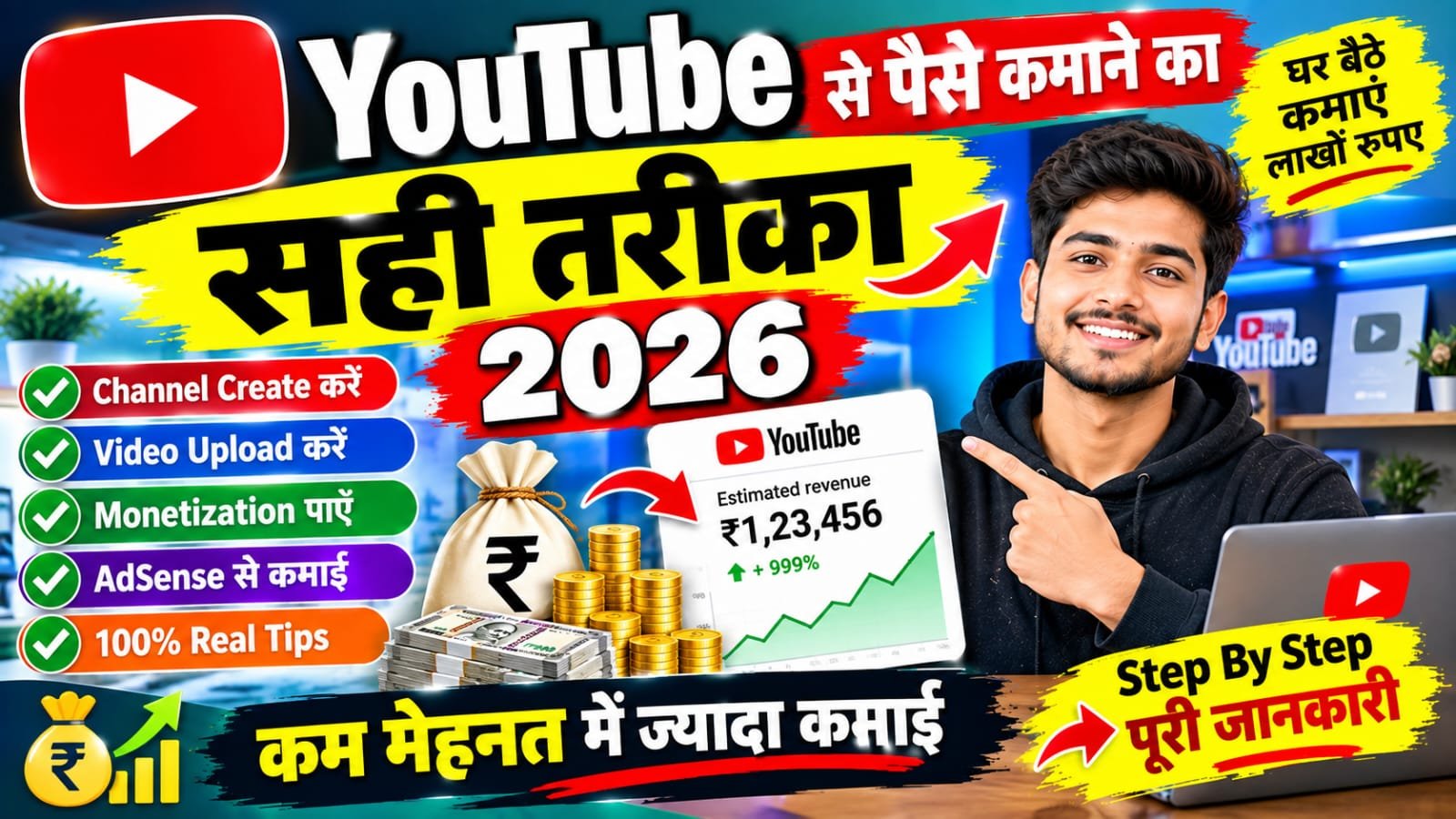
YouTube remains one of the most accessible platforms for turning content creation into income. However, the rules are shifting significantly in 2026, and creators who understand the new landscape early will have a clear advantage. Whether you’re just starting out or already have an established channel, here’s everything you need to know about making money on YouTube this year.
The New Reality YouTube Partner Program Thresholds Are Changing
The most important update for 2026 is that YouTube is raising the entry requirements for its Partner Program (YPP), effective February 1, 2027. If you’re already in YPP, your status won’t be affected. But if you’re planning to apply, the bar is getting higher .
Current requirements (before Feb 2027):
- 1,000 subscribers + 4,000 watch hours in the last 12 months, OR
- 1,000 subscribers + 10 million Shorts views in the last 90 days
New requirements (from Feb 2027):
- 8,000 qualified watch hours in the last 365 days, OR
- 20 million qualified Shorts views in the last 90 days
The watch hour requirement has effectively doubled. YouTube says this change is designed to reward “active creators” and ensure the program remains sustainable as the platform grows .
There’s also an early access tier for smaller creators with just 500 subscribers. This tier doesn’t include ad revenue sharing, but it unlocks fan funding features like channel memberships, Super Thanks, and YouTube Shopping .

How Much You Actually Earn The Numbers Behind YouTube Income
Understanding the difference between CPM and RPM is critical. CPM is what advertisers pay YouTube per 1,000 impressions. RPM is what you actually receive after YouTube takes its 45% cut .
Long-Form Videos
For long-form content, most creators earn between $1 and $5 per 1,000 views on average. But the range is enormous depending on your niche :
- Finance and business: $12 to $35 RPM
- Technology: $6 to $18 RPM
- Health and fitness: $5 to $12 RPM
- Gaming and entertainment: $1 to $5 RPM
- Music: $1 to $3 RPM
A finance channel with 100,000 views can earn $1,200 to $3,500, while a gaming channel with the same view count might see just $200 to $500 .
YouTube Shorts
Shorts pay dramatically less per view. Most creators earn between $0.03 and $0.10 RPM on Shorts . That means 1 million Shorts views might generate just $30 to $100 .
To put this in perspective: a long-form video earning $2 RPM at 1 million views generates $2,000. The same 1 million views on Shorts might generate $30 .
This gap exists because Shorts revenue works on a shared pool model. Ad revenue from the Shorts feed goes into a collective pot, and creators receive a share based on their portion of total Shorts views .
Critical update: Starting February 2027, creators need 10 million qualified Shorts views over 90 days to remain eligible for Shorts ad revenue sharing. Channels below this threshold stay in YPP and keep earning from long-form content, with Shorts revenue resuming automatically when they cross the threshold again .
The Biggest Opportunity Sponsorships
Here’s what many creators miss: ad revenue is often the smallest part of a successful YouTube business.
Sponsorships pay dramatically better. A finance channel can command $40 to $80 per 1,000 views for a sponsored integration — compared to $12 to $35 from ads . Even a lifestyle or vlog channel can earn $15 to $30 sponsorship CPM, which is 3 to 6 times higher than ad revenue .
For many creators, brand deals account for 60 to 80% of Shorts-driven income, with merchandise and digital products adding another 10 to 25% .
Best Niches for Earning in 2026
A 2026 study of small channels under 100,000 subscribers identified the most profitable niches for breakout growth. The top performers combined high advertiser demand with formats that smaller creators could execute :
S-Tier (highest potential):
- Personal finance: $15 to $22 CPM
- Real estate: $10 to $30 CPM
- Evidence-led fitness: $11 to $16 CPM
A-Tier:
- Automotive advocacy: $10 to $20 CPM
- Honest home improvement: $8 to $15 CPM
The key insight: it’s not about picking a broad category. It’s about finding a specific format that builds trust with a valuable audience .
What YouTube Is Cracking Down On
YouTube has tightened its policies around “inauthentic content” as of July 2026. Three categories are now ineligible for monetization :
- Generic, repetitive, or template-based content — mass-produced videos with minimal variation
- Off-putting content — material designed to distress or manipulate viewers emotionally
- AI personas discussing sensitive topics — AI-generated characters giving advice on finance, health, or legal matters
This doesn’t mean AI is banned. YouTube says it’s “agnostic” about the tools creators use. The policy targets content that lacks originality and effort, not the use of AI itself .
Practical Strategies to Maximize Your Earnings
Use Shorts as a funnel, not a destination. Shorts are powerful for discovery and subscriber growth, but the real ad money is in long-form content. Creators who combine both formats grow 41% faster than those using a single format .
Diversify beyond ad revenue. The most successful creators layer multiple income streams: sponsorships, affiliate marketing, merchandise, digital products, and channel memberships. For many, ads are just 20 to 40% of total income .
Target higher-CPM audiences. A view from the US, UK, or Canada can be worth 5 to 10 times more than a view from a lower-CPM region . If you’re creating in English, you’re naturally positioned for higher-paying markets.
Plan around seasonality. Q4 (October to December) sees CPMs spike as advertisers spend holiday budgets. January sees a sharp drop of 50% or more. Some creators report December earnings doubling compared to January .
Accept the new terms. If you’re already in YPP, you need to accept the updated Watch Page Monetization Module, Shorts Monetization Module, and Commerce Product Module by January 31, 2027. Without acceptance, you’ll stop earning from those features .
The Bottom Line
YouTube in 2026 rewards creators who treat it as a business, not just a hobby. The platform is raising barriers to entry, but it’s also introducing new incentive programs and expanding Premium Lite to more countries, which could mean higher earnings for established creators .
The creators who succeed will be those who build audiences in valuable niches, diversify their income streams, and use Shorts strategically to feed long-form content where the real revenue lives.
Start with a clear niche, focus on quality over quantity, and build multiple revenue streams from day one. Ad revenue alone rarely pays the bills — but a well-executed YouTube strategy can.